
 ,
Georges Abessika Kouakou Yao,
Joseph Moroh Akaza,
Agoh Etrand Junior,
Bi Boh Nestor Gore,
Selastique Doffou Akaffou
,
Georges Abessika Kouakou Yao,
Joseph Moroh Akaza,
Agoh Etrand Junior,
Bi Boh Nestor Gore,
Selastique Doffou Akaffou
Mastering nursery production is a critical step for improving the silviculture of Khaya senegalensis, a major commercial forest species in Côte d’Ivoire. However, limited information is available on early-stage variability among progenies and the identification of reliable traits for selection at the nursery stage. This study aimed to analyze growth and developmental variability among six progenies of K. senegalensis in order to identify key morphological traits that can support early selection of superior genotypes. Thirty seeds collected from six mother trees were sown according to genotype using a randomized experimental design. Seedlings were monitored under nursery conditions, and ten agromorphological parameters related to growth and development were measured. The data were analyzed using multivariate statistical approaches, including discriminant analysis, to assess variation among progenies and determine the most informative traits. The results revealed significant variability among the progenies, highlighting the influence of genetic origin on early growth performance. Among the parameters studied, four traits: plant height, leaflet width, number of leaves, and number of internodes were identified as the most discriminant variables, effectively differentiating the progenies. These traits showed strong potential as early indicators of growth vigor and developmental performance. The identification of these key traits provides a practical basis for early selection in nursery conditions, which can enhance the efficiency of seedling production. Ultimately, this approach contributes to the optimization of nursery practices and supports the development of improved silvicultural strategies for K. senegalensis in Côte d’Ivoire.
| Published in | American Journal of Life Sciences (Volume 14, Issue 3) |
| DOI | 10.11648/j.ajls.20261403.11 |
| Page(s) | 60-69 |
| Creative Commons |
This is an Open Access article, distributed under the terms of the Creative Commons Attribution 4.0 International License (http://creativecommons.org/licenses/by/4.0/), which permits unrestricted use, distribution and reproduction in any medium or format, provided the original work is properly cited. |
| Copyright |
Copyright © The Author(s), 2026. Published by Science Publishing Group |
Khaya senegalensis, Nursery Production, Genetic Variation, Agromorphological Traits, Côte d’Ivoire
Parameters | Unit | Description |
|---|---|---|
Height | m | Vertical length from the soil base to the seedling apex |
Number of leaves | - | Total count of fully expanded leaves per seedling |
Number of internodes | - | Total count of stem segments between successive nodes |
Collar diameter | m | Diameter of the stem at the base of the seedling |
Leaf length | m | Distance from leaf base to leaf tip (lamina) |
Leaf width | m | Maximum width of the leaf lamina |
Petiole length | m | Length of the stalk connecting the leaf blade to the stem |
Number of leaf tiers | - | Total number of foliar tiers (nodes) along the main stem |
Leaflet length | m | Length of individual leaflets in compound leaves |
Leaflet width | m | Maximum width of individual leaflets |
Parameters | Minimum value | Maximum value | Mean ± Standard deviation | F | p |
|---|---|---|---|---|---|
Ha | 12,00 | 123,00 | 45,21 ± 19,15 | 6,463 | < 0,001 |
NoFe | 10,00 | 72,00 | 24,92 ± 10,66 | 2,308 | 0,002 |
NoEn | 10,00 | 53,00 | 23,38 ± 6,81 | 4,421 | < 0,001 |
DiCo | 1,2 | 43,00 | 20,26 ± 48,35 | 3,949 | < 0,001 |
LoFe | 3,60 | 44,30 | 16,83 ± 10,45 | 12,057 | < 0,001 |
LaFe | 4,50 | 123,40 | 20,79 ± 7,29 | 1,701 | 0,039 |
LoPe | 2,00 | 48,00 | 21,73 ± 11,79 | 7,995 | < 0,001 |
NoFo | 3,40 | 59,00 | 15,99 ± 9,56 | 5,160 | < 0,001 |
LoFo | 2,3 | 39,6 | 7,91 ± 3,77 | 3,265 | < 0,001 |
LaFo | 0,8 | 16,7 | 6,31 ± 3,24 | 4,793 | < 0,001 |
Parameters | Ha | NoFe | NoEn | DiCo | LoFe | LaFe | LoPe | NoFo | LoFo | LaFo |
|---|---|---|---|---|---|---|---|---|---|---|
Ha | 1,00 | |||||||||
NoFe | 0,5* | 1,00 | ||||||||
NoEn | 0,83** | 0,61* | 1,00 | |||||||
DiCo | 0,08 | 0,09 | 0,14 | 1,00 | ||||||
LoFe | 0,24 | 0,11 | 0,22 | -0,04 | 1,00 | |||||
LaFe | 0,03 | 0,01 | 0,02 | 0,05 | 0,09 | 1,00 | ||||
LoPe | -0,03 | 0,01 | -0,01 | 0,09 | -0,73* | 0,18 | 1,00 | |||
NoFo | 0,43 | 0,24 | 0,42 | -0,01 | 0,70** | -0,11 | -0,53* | 1,00 | ||
LoFo | -0,13 | -0,06 | -0,16 | -0,01 | 0,31 | 0,23 | -0,18 | 0,20 | 1,00 | |
LaFo | 0,17 | 0,10 | 0,22 | 0,06 | -0,28 | 0,15 | 0,51* | -0,14 | -0,43 | 1,00 |
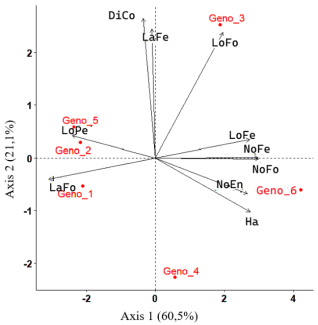
Principal Component | Axis 1 | Axis 2 |
|---|---|---|
Eigenvalue | 6.05 | 2.11 |
Total variance (%) | 60.49 | 21.06 |
Cumulative variance (%) | 60.49 | 81.55 |
Ha | 0.88 | -0.33 |
NoFe | 0.95 | 0.001 |
NoEn | 0.85 | -0.21 |
DiCo | -0.11 | 0.84 |
LoFe | 0.87 | 0.11 |
LaFe | -0.03 | 0.78 |
LoPe | -0.77 | 0.13 |
NoFo | 0.95 | -0.01 |
LoFo | 0.62 | 0.76 |
LaFo | -0.99 | -0.13 |
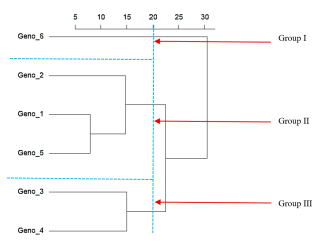
Traits Groups | Ha | NoFo | NoFe | LoFe | NoEn | LaFo | DiCo |
|---|---|---|---|---|---|---|---|
Group I | 38.34±4.71b | 12.08±2.39b | 22.53±1.07b | 11.24±3.80a | 21.46±1.24b | 7.33±0.09a | 20.98±3.10a |
Group II | 45.83±2.98ab | 18.59±2.09ab | 25.48±1.24ab | 22.12±2.62a | 23.02±0.31b | 5.67±0.73b | 20.22±8.06a |
Group III | 64.62±22.82ab | 22.51±12.58a | 30.95±7.58a | 22.99±9.95a | 29.82±7.68a | 20.55±4.84b | 18.19±10.36a |
F | 14.58 | 9.63 | 21.18 | 7.85 | 24.58 | 18.79 | 0.10 |
p | 0.03 | 0.05 | 0.02 | 0.06 | 0.01 | 0.02 | 0.90 |
Traits | F | p |
|---|---|---|
Ha | 14.58 | 0.028 |
LaFo | 18.79 | 0.02 |
NoFe | 21.17 | 0.02 |
NoEn | 24.58 | 0.01 |
Parameters | Genotype 1 | Genotype 2 | Genotype 3 | Genotype 4 | Genotype 5 | Genotype 6 | p |
|---|---|---|---|---|---|---|---|
Ha | 42,96±13,94a | 33,54±10,81b | 43,72±13,08a | 47,93±19,05a | 38,5±16,59b | 64,62±22,82c | < 0,001 |
NoFe | 22,65±5,16bc | 21,4±4,55c | 26,36±20,41b | 24,6±8,24bc | 23,53±6,35bc | 30,95±7,58a | < 0,001 |
NoEn | 21,82±5,19a | 20,07±4,86b | 22,79±5,82a | 23,25±6,43a | 22,5±6,27a | 29,82±7,68c | < 0,001 |
DiCo | 22,22±5,66a | 17,44±8,24b | 13,56±5,55c | 14,52±10,71d | 23,26±6,34a | 18,19±10,36b | < 0,001 |
LoFe | 8,94±2,39a | 15,63±8,96b | 23,98±12,89c | 20,27±8,72d | 9,14±2,71a | 22,99±9,95c | < 0,001 |
LaFe | 8,94±2,39ab | 15,63±8,96c | 23,98±12,89c | 20,27±8,72a | 9,14±2,71cd | 22,99±9,95bd | < 0,001 |
LoPe | 31,93±7,54a | 22,67±10,94b | 16,64±10,98c | 13,64±9,27d | 29,14±6,95e | 16,37±11,24c | < 0,001 |
NoFo | 14,51±8,09ab | 11,99±4,91a | 20,06±9,32c | 17,11±8,02b | 9,73±5,9d | 22,5±12,58c | < 0,001 |
LoFo | 7,22±3,31c | 6,97±3,18c | 10,58±4,35a | 6,29±2,76c | 7,4±3,11c | 8,99±3,98b | < 0,001 |
LaFo | 18,32±7,57ab | 23,4±11,88c | 22,81±4,98c | 18,12±4,66a | 21,52±5,33cd | 20,55±4,84bd | < 0,001 |
ANOVA | Analysis of Variance |
CNRA | National Center for Agronomic Research (Centre National de Recherche Agronomique) |
DFA | Discriminant Factor Analysis |
DiCo | Collar Diameter |
F | Fisher’s Test Statistic |
Ha | Height |
HCA | Hierarchical Cluster Analysis |
K. senegalensis | Khaya Senegalensis |
LaFe | Leaf Width |
LaFo | Leaflet Width |
LSD | Least Significant Difference |
LoFe | Leaf Length |
LoFo | Leaflet Length |
LoPe | Petiole Length |
m | Meter |
MANOVA | Multivariate Analysis of Variance |
NoEn | Number of Internodes |
NoFe | Number of Leaves |
NoFo | Number of Leaf Tiers (Nodes) |
p | P-value |
PCA | Principal Component Analysis |
UPGMA | Unweighted Pair-Group Method with Arithmetic Mean |
| [1] | Rodríguez-Veiga P, Carreiras JMB, Quegan S, Heiskanen J, Pellikka P, Adhikari H, Araza A, Herold M, Cartus O, Smallman TL, Williams M, Nwobi CJ, Tsutsumida N, Ryan CM, Brade T, Nezha Acil N, Balzter, H. Loss of tropical moist broadleaf forest has turned Africa’s forests from a carbon sink into a source. Scientific Reports, 2025; 15, 41744. |
| [2] | Dossou J, Ouinsavi CAIN. Estimating impact of leaf harvest on diameter growth and survival of fodder trees in West African savannah. Global Ecology and Conservation, 2025; 64, e03987. |
| [3] | Tre BIG, Koffi KG, Kouonon LC, Koffi KA, Pereda-Loth V, Sie, RS. Characterization of the demographic and spatial structures of three natural populations of Khaya senegalensis in Côte d’Ivoire. Journal of Tropical Forest Science, 2025; 37(4) (2025): 475–83. |
| [4] | Adji BI, Letort V, Wang X, Kang M, De Reffye P, Jaeger M, Cilas C, Kouassi KH, Duminil J, Sabatier S. Rethinking iconic species reforestation in West Africa: Seed shape harnessing is strategic for enhanced germination and vigorous growth in Khaya senegalensis and Parkia biglobosa. Forests, 2023; 14(7), 1311. |
| [5] | Langa AM, Padonou EA, Akabassi GC, Assogbadjo AE. Caractérisation écophénotypique et aptitude à la germination des grains de Khaya senegalensis (Desr.) A. Juss. Au Tchad. Institut National des Recherches Agricoles du Bénin [Ecophenotypic characterization and germination ability of seeds of Khaya senegalensis (Desr.) A. Juss. in Tchad. National Institute of Agricultural Research of Benin], 2021; 30(1) 44-55. |
| [6] | Langa, AM, Padonou EA, Akabassi GC, Akakpo BA, Assogbadjo AE. Diversity and structure of Khaya senegalensis habitats along phytogeographical zones in Chad (Central Africa): Implications for Conservation and Sustainable Use. Journal of Environmental Geography. 2024; 17(1-4): 45-56. |
| [7] | Devanand PS, Hemaprabha K, Radha P, Kumar P, Raja N, Sivakumar B, Kiruba M, Utharasu S, Kiruthik Suruthi VP, Revathi R. Development of in vitro protocol for Khaya senegalensis. International Journal of Advanced Biochemistry Research. 2024; 8(7): 1118-1123. |
| [8] | Murariu G, Dinca L, Munteanu D. Trends and applications of principal component analysis in forestry research: A literature and bibliometric review. Forests, 2025; 16(7), 1155. |
| [9] | Bakker, JD. Discriminant analysis - Applied multivariate statistics in R. University of Washington, Seattle, WA. 2024; University Pressbook (online). |
| [10] | Redalyc Editorial Board. Multivariate statistical analysis of physicochemical parameters using PCA and HCA techniques. Eclética Química [Eclectic Chemistry], 2023; 48(4), P. 37-47. |
| [11] | Cendana, M. & Kuo, R.-J. C. Categorical data clustering: A bibliometric analysis and taxonomy. Machine Learning and Knowledge Extraction, 2024; 6(2), 1009–1054. |
| [12] | R Core Team. R: A language and environment for statistical computing. R Foundation for Statistical Computing, 2025; Vienna, Austria. |
| [13] | Zobel B, Talbert J. Applied forest tree improvement. New York: John Wiley & Sons; 1984, 505 p. |
| [14] | White TL, Adams WT, Neale DB. Forest genetics. Wallingford: CABI Publishing; 2007, 682 p. |
| [15] | Falconer DS, Mackay TFC. Introduction to quantitative genetics. 4th ed. Harlow (UK): Longman Group Ltd; 1996. 464 p. |
| [16] | Wright JW. Introduction to forest genetics. New York (NY): Academic Press; 1976. 463 p. |
| [17] | Hamrick JL, Godt MJW. Effects of life history traits on genetic diversity in plant species. Philosophical Transactions of the Royal Society of London Series B: Biological Sciences. 1996; 351(1345): 1291–1298. |
| [18] | Loveless MD, Hamrick JL. Ecological determinants of genetic structure in plant populations. Annual Review of Ecology and Systematics. 1984; 15: 65–95. |
| [19] | Lowe AJ, Boshier D, Ward M, Bacles CFE, Navarro C. Genetic resource impacts of habitat loss and degradation: reconciling empirical evidence and predicted theory for neotropical trees. Heredity. 2005; 95: 255–273. |
| [20] | Frankham R, Ballou JD, Briscoe DA. Introduction to Conservation Genetics. 2nd ed. Cambridge (UK): Cambridge University Press; 2010. 642 p. |
| [21] | Reis CAF, Assis TF, Santos AM, Paludzyszyn Filho E. Early growth and genetic parameters in African mahogany (Khaya spp.) progeny tests. Silvae Genetica. 2015; 64(1–6): 33–40. |
| [22] | Cornelius JP. Heritabilities and additive genetic coefficients of variation in forest trees. Canadian Journal of Forest Research. 1994; 24(2): 372–379. |
| [23] | Boshier D, Broadhurst L, Cornelius J, Gallo L, Koskela J, Loo J, Petrokofsky G, St Clair B. Is local best? Examining the evidence for local adaptation in trees and its scale. Environ Evid. 2015; 4: 20. |
| [24] | Orwa C, Mutua A, Kindt R, Jamnadass R, Simons A. Agroforestree database: a tree reference and selection guide version 4.0. Nairobi: World Agroforestry Centre; 2009. |
| [25] | Muchugi A, Kadu C, Kindt R, Kipruto H, Lemurt S, Olale K, Nyadoi P, Dawson, I, Jamnadass, R. Molecular markers for tropical trees: a practical guide to principles and procedures. Nairobi: World Agroforestry Centre (ICRAF); 2008. |
| [26] | Adji BI, Akaffou DS, Sabatier S. Variation de la morphologie des unités de croissance chez Khaya senegalensis (Desr.) A. Juss., 1830 (Meliaceae) et Pterocarpus erinaceus Poir., 1804 (Fabaceae) selon l’habitat et le climat. Bois & Forêts des Tropiques [Variation in growth unit morphology in Khaya senegalensis (Desr.) A. Juss. (Meliaceae) and Pterocarpus erinaceus Poir. (Fabaceae) according to habitat and climate]. 2022; 354: 41-54. |
| [27] | Karan M, Evans DS, Reilly D, Schulte K, Wright C, Innes D, Holton TA, Nikles DG, Dickinson GR. Rapid microsatellite marker development for African mahogany (Khaya senegalensis, Meliaceae) using next-generation sequencing and assessment of its intra-specific genetic diversity. Molecular Ecology Resources. 2012; 12(2): 344-353. https://doi.org/10.1111/j.1755?0998.2011.03080.x |
| [28] | Ky?Dembele C, Tigabu M, Bayala J, Odén PC. Inter-and intra?provenances variations in seed size and seedling characteristics of Khaya senegalensis A. Juss in Burkina Faso. Agroforestry Systems. 2014; 88(2): 311-320. |
| [29] | Faria JCT, Konzen ER, Caldeira MVW, de Oliveira Godinho T, Maluf LP, Moreira SO, da Silva Carvalho C, Leal BSS, Dos Santos Azevedo C, Momolli DR, da Costa Pinto Coelho GT, de Oliveira CMB, Soares TCB. Genetic resources of African mahogany in Brazil: genomic diversity and structure of forest plantations. BMC Plant Biology. 2024 Sep 13; 24(1): 858. |
| [30] | Duminil J, Kang MZ, Letort V, Wang X, De Reffye P, Jaeger M, Sabatier SA. Rethinking iconic species reforestation in West Africa: Seed shape harnessing is strategic for enhanced germination and vigorous growth in Khaya senegalensis and Parkia biglobosa. Forests. 2023; 14(7): 1311. |
APA Style
Gbotto, A. A., Yao, G. A. K., Akaza, J. M., Junior, A. E., Gore, B. B. N., et al. (2026). Growth and Development Dynamics Among Khaya senegalensis Progenies in Côte d'Ivoire. American Journal of Life Sciences, 14(3), 60-69. https://doi.org/10.11648/j.ajls.20261403.11
ACS Style
Gbotto, A. A.; Yao, G. A. K.; Akaza, J. M.; Junior, A. E.; Gore, B. B. N., et al. Growth and Development Dynamics Among Khaya senegalensis Progenies in Côte d'Ivoire. Am. J. Life Sci. 2026, 14(3), 60-69. doi: 10.11648/j.ajls.20261403.11
@article{10.11648/j.ajls.20261403.11,
  author = {Anique Ahou Gbotto and Georges Abessika Kouakou Yao and Joseph Moroh Akaza and Agoh Etrand Junior and Bi Boh Nestor Gore and Selastique Doffou Akaffou},
  title = {Growth and Development Dynamics Among
Khaya senegalensis Progenies in Côte d'Ivoire},
  journal = {American Journal of Life Sciences},
  volume = {14},
  number = {3},
  pages = {60-69},
  doi = {10.11648/j.ajls.20261403.11},
  url = {https://doi.org/10.11648/j.ajls.20261403.11},
  eprint = {https://article.sciencepublishinggroup.com/pdf/10.11648.j.ajls.20261403.11},
  abstract = {Mastering nursery production is a critical step for improving the silviculture of Khaya senegalensis, a major commercial forest species in Côte d’Ivoire. However, limited information is available on early-stage variability among progenies and the identification of reliable traits for selection at the nursery stage. This study aimed to analyze growth and developmental variability among six progenies of K. senegalensis in order to identify key morphological traits that can support early selection of superior genotypes. Thirty seeds collected from six mother trees were sown according to genotype using a randomized experimental design. Seedlings were monitored under nursery conditions, and ten agromorphological parameters related to growth and development were measured. The data were analyzed using multivariate statistical approaches, including discriminant analysis, to assess variation among progenies and determine the most informative traits. The results revealed significant variability among the progenies, highlighting the influence of genetic origin on early growth performance. Among the parameters studied, four traits: plant height, leaflet width, number of leaves, and number of internodes were identified as the most discriminant variables, effectively differentiating the progenies. These traits showed strong potential as early indicators of growth vigor and developmental performance. The identification of these key traits provides a practical basis for early selection in nursery conditions, which can enhance the efficiency of seedling production. Ultimately, this approach contributes to the optimization of nursery practices and supports the development of improved silvicultural strategies for K. senegalensis in Côte d’Ivoire.},
 year = {2026}
}
TY  - JOUR
T1  - Growth and Development Dynamics Among
Khaya senegalensis Progenies in Côte d'Ivoire
AU  - Anique Ahou Gbotto
AU  - Georges Abessika Kouakou Yao
AU  - Joseph Moroh Akaza
AU  - Agoh Etrand Junior
AU  - Bi Boh Nestor Gore
AU  - Selastique Doffou Akaffou
Y1  - 2026/05/11
PY  - 2026
N1  - https://doi.org/10.11648/j.ajls.20261403.11
DO  - 10.11648/j.ajls.20261403.11
T2  - American Journal of Life Sciences
JF  - American Journal of Life Sciences
JO  - American Journal of Life Sciences
SP  - 60
EP  - 69
PB  - Science Publishing Group
SN  - 2328-5737
UR  - https://doi.org/10.11648/j.ajls.20261403.11
AB  - Mastering nursery production is a critical step for improving the silviculture of Khaya senegalensis, a major commercial forest species in Côte d’Ivoire. However, limited information is available on early-stage variability among progenies and the identification of reliable traits for selection at the nursery stage. This study aimed to analyze growth and developmental variability among six progenies of K. senegalensis in order to identify key morphological traits that can support early selection of superior genotypes. Thirty seeds collected from six mother trees were sown according to genotype using a randomized experimental design. Seedlings were monitored under nursery conditions, and ten agromorphological parameters related to growth and development were measured. The data were analyzed using multivariate statistical approaches, including discriminant analysis, to assess variation among progenies and determine the most informative traits. The results revealed significant variability among the progenies, highlighting the influence of genetic origin on early growth performance. Among the parameters studied, four traits: plant height, leaflet width, number of leaves, and number of internodes were identified as the most discriminant variables, effectively differentiating the progenies. These traits showed strong potential as early indicators of growth vigor and developmental performance. The identification of these key traits provides a practical basis for early selection in nursery conditions, which can enhance the efficiency of seedling production. Ultimately, this approach contributes to the optimization of nursery practices and supports the development of improved silvicultural strategies for K. senegalensis in Côte d’Ivoire.
VL  - 14
IS  - 3
ER  -
Department of Agronomy and Forestry, University of Jean Lorougnon Guede, Daloa, Côte d’Ivoire
Department of Agronomy and Forestry, University of Jean Lorougnon Guede, Daloa, Côte d’Ivoire
Department of Agronomy and Forestry, University of Jean Lorougnon Guede, Daloa, Côte d’Ivoire
Department of Agronomy and Forestry, University of Jean Lorougnon Guede, Daloa, Côte d’Ivoire
Department of Agronomy and Forestry, University of Jean Lorougnon Guede, Daloa, Côte d’Ivoire
Department of Agronomy and Forestry, University of Jean Lorougnon Guede, Daloa, Côte d’Ivoire

Information


 Share This Article
 Twitter
 Linked In
 Facebook
 Copy
Copy Download